Arab Football Federation’s 2026/27 Competition Season Kicks Off on Thursday.. Egypt’s Port Said to Host Fifth Edition of Arab Beach Soccer Cup
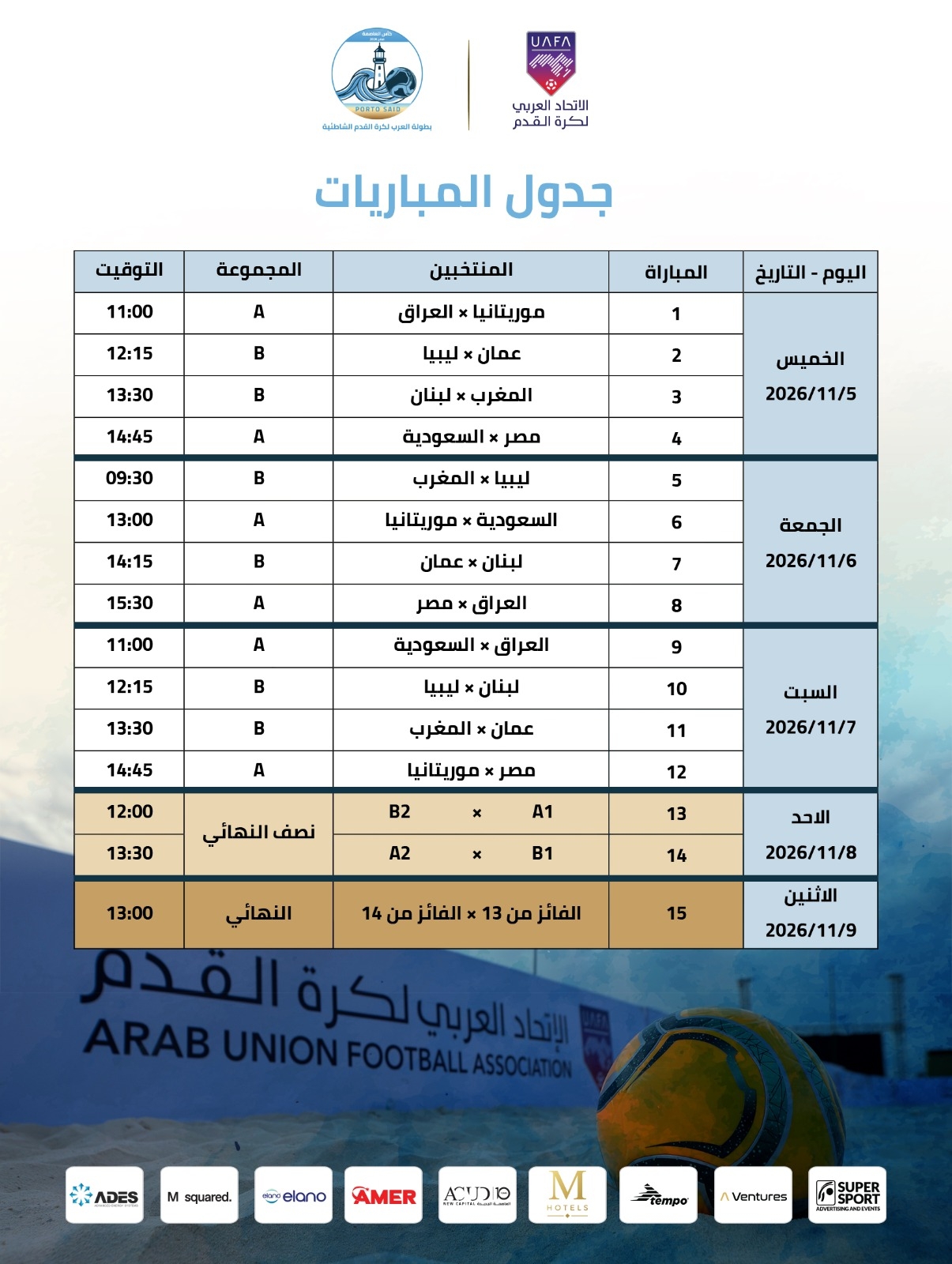
The fifth edition of the Arab Beach Soccer Cup is set to kick off this Thursday, marking the opening of the Arab Football Federation’s (UAFA) 2026/27 competition season. Hosted by the Egyptian Football Association, the tournament will take place in Port Said, Egypt, from 5 to 10 November 2026.
Eight national teams will compete for the prestigious “Capital Cup” trophy at Porto Said Stadium: defending champions Egypt, Oman, Saudi Arabia, Morocco, Mauritania, Lebanon, Iraq, and Libya.
The participating teams have been divided into two groups of four, based on Arab and international football rankings.
Group A features hosts and defending champions Egypt, alongside Saudi Arabia, Mauritania, and Iraq.
Group B comprises Oman, runners-up in the previous edition, together with Morocco, Lebanon, and Libya.
History of the Arab Beach Soccer Cup
The inaugural Arab Beach Soccer Cup was held in Egypt in 2008, three years after FIFA officially brought beach soccer under its umbrella in 2005. Libya claimed the first Arab title, defeating the United Arab Emirates, who finished as runners-up.
The second edition took place in Saudi Arabia in 2010, with the hosts lifting the trophy and the United Arab Emirates once again finishing second.
Egypt hosted the third edition in 2014, when the Egyptian national team secured the title, while Lebanon finished as runners-up.
The fourth edition was staged in Saudi Arabia in 2023, with Egypt successfully claiming the championship and Oman taking second place.
The Origins and Evolution of Beach Soccer
Beach soccer first emerged on the beaches of Brazil during the 1950s as a recreational activity. Due to the challenging nature of playing on sand, the sport gradually developed a distinctive style characterised by technical improvisation, creativity, flair, and exceptional physical fitness.
As the game spread to beaches around the world, beach soccer evolved from a casual recreational pastime into a professional sport.
A significant milestone in its development was the establishment of Beach Soccer Worldwide (BSWW) in Los Angeles, which helped introduce the first standardised rules for the sport. These included dividing matches into three 12-minute periods and eliminating draws, ensuring that every match produces a winner.
Official FIFA Recognition (2005)
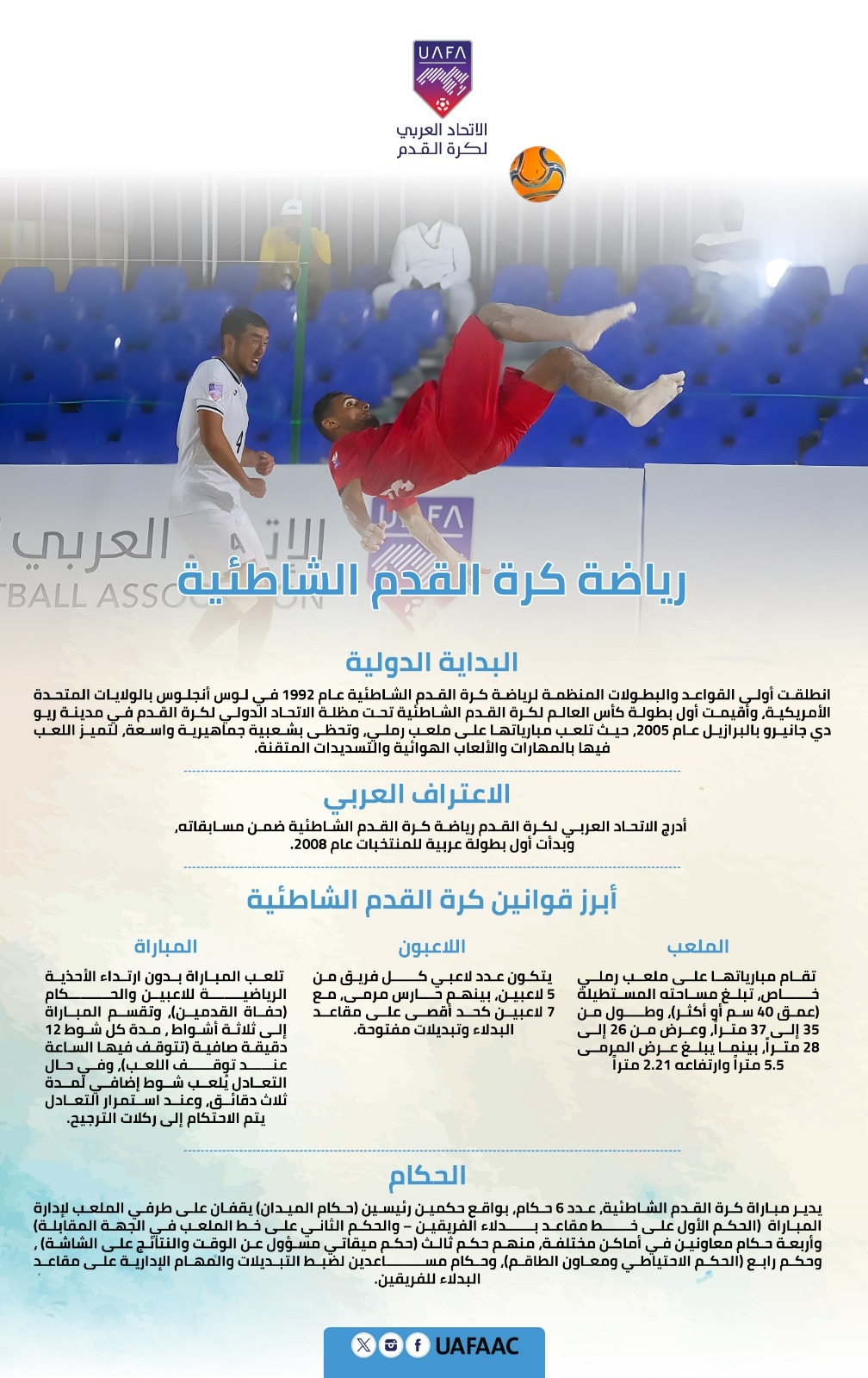
Beach soccer continued to grow internationally until FIFA became formally involved in its organisation and staged the first FIFA Beach Soccer World Cup in 2005.
This marked a turning point in the sport’s development, strengthening its international recognition and expanding its presence across continents.
Since FIFA assumed responsibility for organising the Beach Soccer World Cup in 2005, a total of 13 official editions have been held.
Brazil leads the all-time standings with seven titles, including consecutive triumphs in 2024 and 2025.
Russia follows with three titles, most recently winning the 2021 edition, while Portugal has claimed two championships, in 2015 and 2019.
France has won the competition once, securing the title in the inaugural FIFA-organised edition in 2005.
Key Rules of Beach Soccer
Beach soccer is governed by official FIFA Laws of the Game specifically adapted to the unique conditions of playing on sand. These regulations are designed to promote fast-paced action, technical skill, attacking football, and high-scoring matches.
Team Composition and Substitutions
Each team may name a squad of 12 players, with five players on the pitch at any given time: one goalkeeper and four outfield players.
The remaining seven players serve as substitutes, including a reserve goalkeeper.
Unlimited substitutions are permitted during play without requiring the referee’s prior authorisation, provided the outgoing player leaves the pitch through the designated substitution zone before the replacement enters.
Match Duration
A beach soccer match consists of three equal periods of 12 minutes of effective playing time each.
The clock is stopped whenever a goal is scored, a foul is committed, or the ball goes out of play.
Extra Time and Penalty Shootouts
Matches cannot end in a draw.
If the scores are level at the end of regulation time, an additional three-minute period is played.
If the teams remain tied after extra time, the winner is determined through a penalty shootout.
Under the shootout procedure described, each team initially takes five kicks. If the scores remain level, the shootout continues on a sudden-death basis until a winner emerges.
The winning team is awarded one point under the relevant competition scoring provisions.
Free Kicks
Unlike traditional association football, players are not permitted to form a defensive wall during free kicks.
When a foul is committed in a team’s own half, all players must remain behind the ball until the free kick is taken.
If a foul occurs in the opposing half, players must remain at least five metres away from the ball and cannot form a defensive wall.
Free kicks must generally be taken by the player against whom the offence was committed, unless an injury prevents that player from doing so.
Once the referee signals for play to restart, the player has four seconds to take the kick. Failure to do so results in a free kick being awarded to the opposing team.
Kick-offs, Offside and Touchline Restarts
A goal cannot be scored directly from a kick-off in beach soccer.
There is no offside rule.
Another distinctive feature of the sport is that players may restart play from the touchline using either a throw-in or a kick-in.
The Playing Surface and Pitch Dimensions
Beach soccer pitches must be covered with sand to a minimum depth of 40 centimetres.
The playing area measures between 35 and 37 metres in length and between 26 and 28 metres in width, with boundary lines measuring 10 centimetres in width.
Each goal measures 5.5 metres wide and 2.2 metres high.
The halfway line is marked by red indicators, while an imaginary line, identified by yellow markings nine metres from each goal line, defines the penalty area.
Penalty kicks are taken from the midpoint of this imaginary line.
Substitution zones are located along the touchline, in a similar arrangement to futsal.
Ball Specifications
The ball has a circumference of between 68 and 70 centimetres, similar to a conventional football, but is lighter and specifically designed for use on sand.
Its weight ranges from 400 to 440 grams, with an air pressure of between 0.4 and 0.6 atmospheres at sea level before each match.
Match Officials and Disciplinary Regulations
Beach soccer matches are officiated by two referees, both of whom have full authority to enforce the Laws of the Game.
They are assisted by a third referee and a timekeeper, who are positioned at the officials’ table near the halfway line, on the same side of the pitch as the team benches.
If a player is sent off after receiving a direct red card or a second yellow card, the team may introduce a substitute after two minutes have elapsed following the dismissal, subject to the applicable rules.
Unlike certain other forms of football, there is no fixed limit on the total number of fouls an individual player may commit during a match.